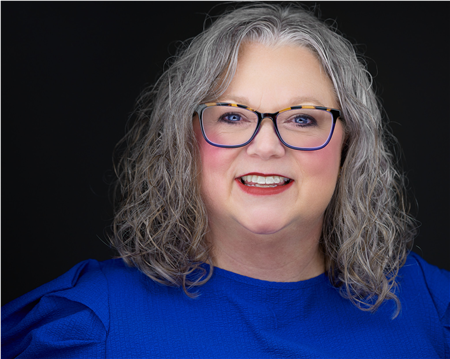
On February 27, 2026, at Lincoln South Rotary Club, we heard from Kiersten Hill - Firespring Director of Nonprofit Solutions.
Kiersten told us about The Value of Storytelling for Impact and Connection.
During her presentation her goal was to tell us about Firespring and the work they do to help nonprofits. But, also how storytelling can help us in our Rotary work.
She explained that we should look at storytelling as an art - you will want to share your story so that it is educational but also entertaining. Storytelling is important to nonprofits. Providing a list of facts may be educational and interesting, but it is not impactful. Instead, stories stick with us - we can recall them and share with others.
Kiersten explained that brains are hardwired to think in terms of stories. She said that when we are listening to a story, it connects to the area of the brain that processes motion and movement. When we connect to a story we automatically want to do something - take action.
She shared that storytelling has an economic impact for nonprofits.
- - 22x more memorable when using storytelling than facts
- - 56% of followers will take further action such as making a donation after reading a compelling story published by a nonprofit
Kiersten's life story is interesting - her education, careers and life changes. She grew up in North Platte and got her degree from UNL in Communication Studies - a somewhat general field.
She married right out of college and moved to Hastings for her husband's work. She did not know anyone - had no friends - but she started checking around for work in her field. She said she "fell into" a job at United Way as the Administrative Assistant. After just one campaign, the Director left and she filled that position. That is where she learned how to run a nonprofit.
After a few years, knowing she could make more money she went into a for profit job - a drug distributer. She had a goal of seeing 7 doctors per day with a territory from Alliance to McCook. It was a culture shock - to go from a nonprofit to profit - to be concerned with tight budgets to seeing money "flowing freely". She moved out of that job - did a few other things in advertising and communications.
With a transfer for her husband they moved to Seward. Within a couple of weeks they learned that they had a baby through adoption.
Kiersten joined Lincoln 14 Rotary. She knew she would want to get back into nonprofit work. She spent time at Give Nebraska, Big Brothers/Big Sisters, Children's Zoo where she helped with their capital campaign. With all of those - she had always used Firespring for printing and websites.
Kiersten referred to a book by Donald Miller - "Building a Story Brand". She said that is what she does when she helps nonprofits. She does almost all of the educational training. She stated that her position did not really exist before so it was developed. Besides education, she helps nonprofits with their brand stories, and she provides education within Firespring about how nonprofits work.
Talking about Firespring, she said they have clients in all 50 states as well as 8 International clients. The company started out as a printing company, then technology and also marketing. Their goal is always to ensure the success of their clients. They started out as separate divisions and renamed them all to Firespring in 2007. They became Certified in 2014 - certified for public benefit - making decisions on behalf of impact on environment, communities and clients.
Firesring established "Power of 3" program.
1% of revenue is donated to nonprofits
1% of revenue is donated to nonprofits
2% of products are provide as "in-kind"
3% of their full time salary is actually for volunteer work - every employee has 8 hours per month that they can use on volunteer work
When talking about Rotary and storytelling, Kiersten stated that nonprofit organizations save people's lives every day yet we often struggle with how to tell people about us. We need to make people understand why service clubs are important - we want people to see themselves join in our work. When people understand the organization, it builds trust.
As we build a story, we should state the problem, and the solution, and then share the result.