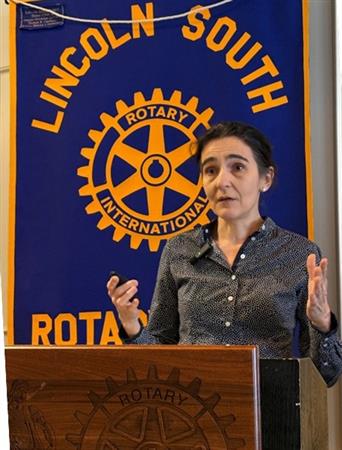
On February 28, 2025 at Lincoln South Rotary Club, we heard from Fullbright Scholar Galia Chimiak. The focus of her presentation was Americans of East European descent supporting the Ukrainian people: preliminary results of a study on grassroots humanitarianism.
Galia conducted a study of Americans of East European descent - asking about their feelings about supporting Ukraine and their motivations for that support. She pointed out that she does not have a personal agenda, her work is a study only. She also stated that the participants self-identified.
She started with some census statistics:
- - Europeans comprise 10 percent of the immigrants in the US in 2022
- - there are 46.2 million immigrants in the US in the 2022 census, and Europeans made up 4.7 of those.
- - of the immigrants in 2022 Eastern European made up 46%
- - Russians previously comprised the largest group of Eastern Europeans in the United States, but in 2022 they were overtaken by Ukrainians
She stated that many university programs were focused on Russian studies with Eastern Europe studies added in. These programs may see some challenges because of the changes in ideals in the countries - they may not all be best served under a single program.
Galia stated that, with the full-scale invasion of Russia into Ukraine, the type of support that she saw in her study:
- - Humanitarian assistance for people and refugees from Ukraine; primarily organized by individuals and nonprofit organizations
- - Advocacy - raising awareness, lobbying for US assistance for the Ukrainian people
- - Fundraising among Americans
- - Military Support - some individuals earmarked specifically for defense, medical aid and to rebuild Ukraine
She found many individuals that supported Ukraine by 1) Volunteers traveling to Europe, 2) individuals in the US sponsoring, or otherwise assisting, refugees from Ukraine, 3) Individuals organizing fundraisers, 4) citizens writing to representatives and 5) individuals in universities introducing new studies.
The various motivations for people - what made them wish to support the people of Ukraine - were varied. Galia shared some specific stories for each motivation she presented.
"They are people like me"
Some individuals could relate to the people - middle class - single mothers, etc.
"Historical Deja-Vu"
Some identified as Polish-American, shared how the experience of the holocaust impacted their families; they recalled the stories of their parents losing their homes and imagined the youth of Ukraine going through that trauma
"Standing Up To The Bully"
Some just want to help the regular person, the one being mistreated, the underdog.
"Humanitarian"
Many people just want to make a difference. Whenever they see violence, mistreatment, they step forward and do what they can to help.
"The Right Thing To Do"
Similar to other reasons, but "how would I live with myself if I didn't do something" feeling.
"Protecting the Motherland"
It is too close to home for some. If it is Ukraine today, maybe it will be us tomorrow? Some immigrants felt guilty leaving their home country, and do not want any others to go through that.
Galia also observed that Americans with Ukrainian roots found strength in those roots again.
BIO
Galia Chimiak is a Fulbright Senior Scholar with the Political Science department at UNL for the 2024-25 academic year. She is a Professor in Sociology with the Institute of Philosophy and Sociology, Polish Academy of Sciences and a co-editor-in-chief of Voluntas: International Journal of Voluntary and Nonprofit Organizations. Her hitherto research and publications have focused on civil society and international development cooperation in Eastern Europe as well as in Ireland. Galia Chimiak has previously taught at a number of Polish universities and at Trinity College Dublin in Ireland. At UNL Galia is teaching a course for Honors students "Helpers and Helping: Voluntary Organizations and Making a Difference in the World".