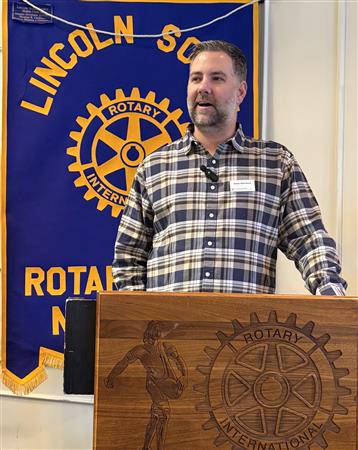
On January 17, 2025 at Lincoln South Rotary Club, we heard from Dave Williams, Chief Archaeologist for the Nebraska State Historical Society.
Dave stated that he has been learning a lot about Nebraska - he is not from here - the job brought him here. There is lots to explore - to learn about the state and people that live here. He has done work in all of the surrounding states.
We got a lesson about science.
Archeology is part of the science of anthropology - the study of human societies and cultures, and their development. As part of that archeology is the study of artifacts, buildings, and other physical remains to understand how people lived in the past. It is the study of past societies and their cultures, especially the material remains of the past, such as tools, food remains, and places where people lived.
He further stated that archeology is different from these sciences:
- Paleontology - the study of fossil plants and animals
- Geology - the study of how the earth was formed
- History - the study of past events, particularly related to humans - they contribute to history by figuring out the stories of past civilizations
One definition of archeology that he shared: “The Study of Material Culture in Time and Space”.
Dave pointed out that the term pre-historic has been used because there are very few written records. Without written history all we have to work from are the tools and structures that were left behind.
He talked about Clovis cultures that are back bout 13,000 years. There have been some clovis archeological sites found in Nebraska.
From the internet: Clovis points are stone spear points with flutes, or grooves, that were used by the Clovis culture during the Paleo-Indian period. They are a key artifact associated with the earliest cultures in North and South America. . . . sharp, triangular in shape . . . traded widely across North America . . . thought to be the oldest tools in North America . . . used to hunt mammoths and mastodons . . . often attached to spears.
It has only been in the last few hundred years that we have access to written documents such as transactions. Without written records, what we are learning from the tools and other artifacts is how we create our history. Through their work they have been about to write a timeline back to the earliest occupation in Nebraska.
Dave showed a map of archeologically documented areas in the State of Nebraska. There are only about 11,000 recorded compared to other states with 50,000 to 100,000 archeologically documented sites. In fact there are 2 counties without any documented sites - Arthur and Logan county.
In the State of Nebraska, 95% of the land is privately-owned. They would need permission to access the land to conduct studies. The primary way that studies get performed is in conjunction with projects - road, wind farm, water line, etc. Any of those projects require a study in advance of the project.
Dave shared about the Archeology Division of the State Historical Society. There are 13 staff. They act as the clearing house for all archeologic work in the State. They check sites before any work can be done to see if anything is documented. And, if anything is found during a project, it is reported to them.
An important part of their public service is sharing / telling the stories. They have a collection on site and they give tours of the facilities and allow viewing of the collections.
There are a number of Federal Laws that dictate their work. Not only are there CFRs (Code of Federal Regulations) but also State Statutes. The State dictations the publications that they must provide and also that presentations and reports are required. He pointed out the three most important Federal Laws:
•National Historic Preservation Act of 1966, as amended
•Archaeological Resources Protection Act of 1979
•Native American Graves Protection and Repatriation Act of 1990
With regard to the Native American Graves Protection and Repatriation Act, he stated that Nebraska actually had laws in place before the Federal laws. It is what dictates that remains must be returned to the native people. If a burial ground is inadvertently found, his office gets involved to determine if they are Native American. And, if not, they work to determine who the recovered individual is so that they can be properly buried.
Dave closed by talking about why archeology is important. Archeological sites and other historic resources provide a perspective on the people and places of the past that cannot be gained in any other way. They are the facts of the past - the evidence. Through the study of our past, we can inform our future - we can know how we got here. It helps provide information about underreported populations (not just the wealthy).
BIO
As Nebraska State Archeologist, Dave Williams: directs the State Archeology Office, a program of the Nebraska State Historical Society (NSHS); oversees Nebraska’s archeological resources under the Nebraska Archeological Resources Preservation Act and National Historic Preservation Act; assists with the identification, recovery, and repatriation of human skeletal remains and consultation with Native American tribes; supervises cultural resource management projects; and disseminates archeological information to the public.
Dave’s cultural resource management experience includes work across the Great Plains, Midwest U.S., Great Basin, Colorado Rockies, and in Oaxaca, Mexico. Prior to joining the NSHS, he was the Assistant State Archeologist and Contracts Manager for the South Dakota State Historical Society. Dave’s research interests include public archeology, geochemical sourcing analysis, long-distance exchange of materials, and precontact ceramic production. Dave received a BA in Anthropology from the University of South Dakota and an MA in Anthropology from the University of Colorado Boulder.