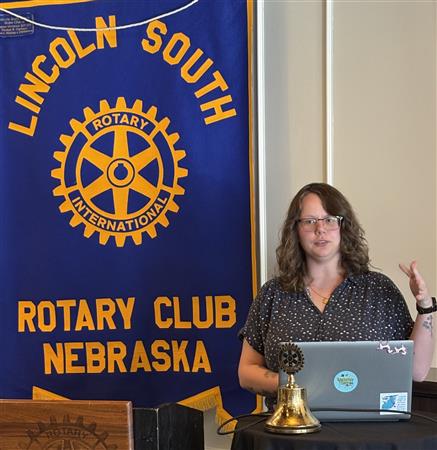
On May 8, 2026 at Lincoln South Rotary Club we heard from Emily Gengenbach. She is the Librarian & Program Coordinator at American Historical Society of Germans from Russia. Her topic is “History of Germans from Russia in the US”.
The title on Emily's power point was Death, Poverty, Bread: How German Russians Found Success in Nebraska.
Thank you, Tom, for these notes: Emily recounted the history of the Germans who migrated from Germany to the Volga area of Russia, and then to the United States and other countries as they searched for religious and political freedom. Interesting fact: Runzas were introduced to Lincoln by the Germans from Russia.
Why did Germans flee to Russia? Per Emily there were wars between European Princes that created poverty, heavy taxation religious persecution and internal conflicts among religious groups. Russia was looking for immigrants to colonize the southeastern part of the Russian Empire.
Emily shared that there were three Russian rulers that had a big impact on Germans immigrating to Russia - Ivan the Terrible, Peter the Great and Catherine the Great. Ivan was the first to invite Germans to move. Catherine was German born and encouraged immigration on a larger scale.
Catherine hoped to ensure that the underdeveloped areas of Russia in the Southeast would finally be productive. The German model of farming would contribute to the overall productivity of Russia.
She added some incentives to encourage more German immigrant - religious freedom, local autonomy, free land, tax exemptions, cash grants and exemption from military service. Between 1763-1768 more than 25,000 Germans immigrated and lived for over 100 years in relative isolation, both from Russian neighbors and their country of origin.
The German colonies were self-sufficient, living away from the Russian neighbors - German children did not play with Russian children. the Germans were prosperous and when they decided to immigrate to the United States their loss impacted the Russian economy.
Emily shared that things changed dramatically under the rule of Czar Alexander II. He took away the autonomy and military freedom. He wanted to "Russionize" them. The government took over control of the local affairs. This was a time when many decided to immigrate to the United States.
As the Germans traveled to North America they were sometimes turned away from New York or Quebec and traveled to South America. But, once they were accepted they traveled by train to the Central Plains. During the late 1800s and 1900s, Lincoln became a major stopping point while they decided their final destination.
Emily shared that, from Lincoln, many German Russians were able to negotiate land purchases in Kansas, Minnesota, the Dakotas and rural Nebraska. Lincoln was a great supply center for horses, wagons and food.
There were many settlements in Nebraska with groups of German Russians - Sutton, Henderson, Hastings, Grand Island, McCook and Scottsbluff. But Lincoln had the largest concentration of German Russians in Nebraska - about 4,000 by 1909. In fact, in 1913, nearly 1/3 of all births were of German Russian parentage.
Throughout Nebraska, many of the immigrants works in sugar beet fields in western Nebraska while others were on Railroad crews. Some also became successful business owners and artisans.
During times when there was anti-German sentiment, many of these immigrants found ways to keep to themselves - more or less hide their heritage. Many moved out of the Lincoln Bottoms to better neighborhoods to distance them from their heritage.
There is much more to learn by visiting the center or https://ahsgr.org/.
BIO
Emily Gengenbach was originally from a small town in Nebraska but came to Lincoln to get her history degree. She then earned her Master of Library and Information Science in May 2025. Emily has worked in public and academic libraries since 2015.
She joined the American Historical Society of Germans from Russia in May 2022, where she is the Librarian and Program Coordinator. Her duties include giving tours, talking to guests and community groups about the history of Germans from Russia, and maintaining their extensive library.