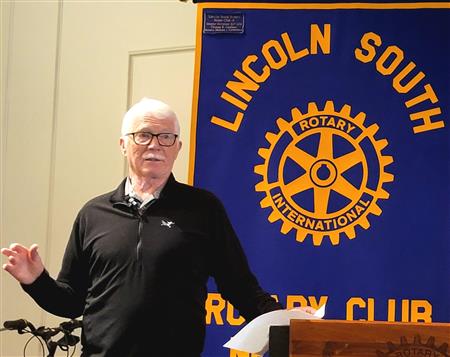
On November 3, 2023 at Lincoln South Rotary Club, our speaker was Clayton Streich of The Bike Kitchen. He talked about the operations and the expansion plans.
Clayton's story of how he came about becoming a volunteer and on the Board of the Bike Kitchen takes many steps. You can see that in his bio.
He talks about the organization with great passion. They are proud of their working model and the fact that it operations on all volunteers. They have very little budget because they purchase very little - most parts are spares. He did discuss the purchase of helmets (which have recently doubled in price) and locks. Every bike comes with a helmet and about half get a bike lock if they are in an area with a high chance of theft.
Children can get a bike up on request of a parent or guardian. Adults needing bikes to get to work or other daily transportation needs, they can contact the Bike Kitchen to find out how they qualify. The Bike Kitchen partners with community organizations to help distribute bikes where there is need. There has been a surge in the need for adult bikes for immigrants.
Clayton explained that there is a person that keeps track of the computer and other requests for bikes. He makes a tag for each with the details - such as height of recipient, if they need a basket, etc. Those tags are all hung on a wire and pulled by volunteers who find the bike that matches the needs. That person is contacted to come to pick up their bike. The volunteers may also arrange for the bike to be delivered.
The volunteers all work on the bikes. They do not always come in with the knowledge to repair but will learn one aspect at a time. Some of the volunteers are mechanical engineer students from UNL. This gives them an opportunity to improve their skills but also needed volunteer service hours.
The process - from start to finish:
- - donated bikes are dropped off at The Bike Kitchen
- - volunteers pick up a bike and start to work
- - at times they find that a bike is not worth the work so it is set aside and used for parts
- - when they decide to work on a bike they go through an extensive check list to ensure the bike is safe and something that a child would want
- - one mechanic will complete a thorough check and place a green dot on the bike clip board
- - a second mechanic will also complete a thorough check and place a green dot
- - having two thorough mechanical checks, the bikes are placed in a selection area
- - volunteers take the tags that came from the requests and match a bike to the details of the request (height, basket, etc.)
- - the bikes are then placed on numbered hooks; the hook number is noted on the clip board
- - the recipient is then contacted so that they can pick up their bike and helmet (and maybe a lock)
On Monday and Thursday nights they have a bike repair clinic. People can bring their bikes in for repair and to learn how to repair minor items. There are times when a bike is beyond repair. There are times when a person obviously does not respect the process. But, Clayton states, they always try to help everyone that needs the help.
Clayton shared a little about the transition of The Bike Kitchen. He said before the pandemic they did a lot of outreach. They would hold repair clinics at events - setting up work areas in parks. Taking the advice of experienced non-profit managers, they decided to two a couple things only - and to do those well. They settled on giving free bikes, and providing a free bike repair clinic.
He said that they have gotten better at tracking the activity and they give away about 1000 bikes per year. He stated that donations of bikes are pretty steady but that they see an influx after a story in the paper. After a recent newspaper article about giving away their 1000th bike this year, the next Monday they had about 30 bikes donated over the weekend. And, they had another 20 the next weekend.
They need a larger space. It is very crowded in their current space. They have been searching and someone finally presented what seemed to be the perfect building - the former Lincoln Municipal Pool building (there is no longer at pool) located at 21st and M streets. The building has housed many City divisions over the years. There has been a challenge because of the number of jurisdictions with an interest in the property as well as the fact that it has historical status. But, Clayton believes it is moving forward.
Clayton Streich is a retired math teacher with a passion for running which then grew into a passion for bicycles. He has participated in many marathons in such places as Lincoln, Omaha, Big Sur (California), Boston, and Dublin (Ireland). Clayton won the masters division of the 1981 Omaha Marathon. That same year he achieved his personal best marathon in Minneapolis with a time of 2 hours and 42 minutes. In 1988, he organized the first Mayor’s Run – a one mile run around the State Capitol building. In 2001, a friend invited him to join in on the Tour de Nebraska, a five-day, non-competitive bicycle tour of rural Nebraska. This experience led to his love of bicycle riding. This passion along with his experiences with young runners led him to become involved in the Lincoln Bike Kitchen in 2014.