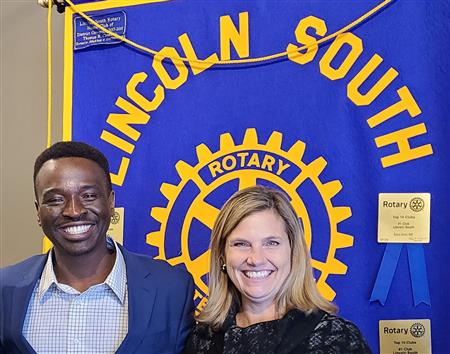
At Lincoln South Rotary Club on October 22, our presenters were Tom Randa and Connie Duncan. They presented information about the Cultural Centers Collaborative.
Tom Randa is the Executive Director of the Good Neighbor Community Center. He shared his journey starting when he traveled to the United States from Kenya at age 18.
His goal was to become an automotive engineer and he was accepted to a college in Washington. He ended up in Washington DC and had to find a way to get to the west coast. Arriving too late to start his studies he thought he would look to his church - he is an Adventist. He found a Seventh-day Adventist Church but upon arriving he was surprised there was no service, unlike in Kenya where they have daily services.
There was a man on the roof doing repairs that offered to help him. Even though that man was not a member of the church, he invited him to his home. They worked to find a solution and decided that the best thing would be to connect him with an Adventist college. So he moved to Lincoln and attended Union College.
He began to work at the Good Neighbor Community Center providing technical support. Other staff members were on medical leave so he took on more duties. He was writing grants and meeting with members of the community. So, when the position of Executive Director opened he was asked to take over because of his extensive knowledge of the organization. His passion has been the food program which has grown to now serving 150 clients.
Tom then told us about the collaboration among the various cultural centers in Lincoln. They have been working together for a number of years but have now launched a project to make that collaboration more effective. It is called the Cultural Centers of Lincoln Collaborative.
The cultural centers that are involved include:
- Good Neighbor Community Center - Tom Randa
- Malone Center - John Goodwin
- Asian Community and Cultural Center - Sheila Dorsey Vinton
- Ponca Tribe of Nebraska - Suzanne Mealer
- El Centro de las Americas - Romeo Guerra
The project team includes:
- Connie Duncan, Project Manager
- Lori Seibel, CHE-Planning, Fundraising, Stakeholder Liaison
- Larry Bearking, Grant Writer - Technical Needs
- Tom Beckius, Planning Volunteer, Facility Needs, Long-Term Financial Stability
Some information provided in a video of the cultural center executives:
Being involved with this collaborative has been the privilege of a lifetime.
We represent five separate cultural centers who share similar goals in providing programming and services to our communities.
The centers are an important refuge for children, teenagers and even adults.
We exist to provide shelter, resources and human connection.
Our goal is to help everyone who comes here achieve success.
Whether at school, raising a family or pursuing a career, this a place to learn, dream, connect with others and grow.
One challenge is that we are spread thin.
The reality is that we don't always have the resources to meet people they are.
We are constantly looking for the answers that will serve the most people.
We could all compete for funding to improve our individual facilities but that would contradict the belief in collaboration.
The audiences we serve are not identical but they deserve the same level of commitment.
We share our most core values to combat challenges we also share.
None of us can make it unless we all make it.
The mission of the Cultural Centers of Lincoln Collaborative: To promote cultural empowerment through collaboration, education and advocacy.
Getting there will not be easy - it is a lofty goal. The collaborative believes that we can build bridges to bring our community together. The construction will need to be designed with the cultures in mind to provide for the communities.
The minority community is continuing to grow. In 1990 it was 13% it is believe that by 2050 it will be at 35.4%. And, looking at the demographic maps of Lincoln, the population of minorities and those in poverty overlap.
There is a history of underfunding of cultural centers. There is a growing client need, but the center lack space. Programming is often funded by grants that do not necessary meet the real community needs. Employees of cultural centers traditionally get low wages. There is consistent under-funding compared to other organizations that are more organized.
The collaborative has identified that the solution is to have a shared campus which would remove inefficiencies and provide space to grow. The team has visited other collaborative organizations and facilities to see how it has worked and provide some ideas for implementing the plan for Lincoln.
Goals
- Intentional collaboration
- Build visibility and trust as community leaders
- Complete a fundraising campaign to fully fund the project
Timeline for capital campaign (tentative)
- Jan 21 - Jan 22 - Collection of data, planning, does the program meet the needs, does programming need to be adjusted; who are current donors
- Jan 22 - June 22 - Community connections
- June 22 - June 23 - Fundraising and Campus Development; a Lincoln destination campus; Malone center may be torn down, what services are needed on campus? all need early childhood programs, need more room for food distribution as well as drive-up; hope to have beautiful space that will showcase cultures; also meeting space that can be rented by other non-profits; hope to have sports facilities; all centers will be within walking distance of each other
- June 23 - 2024 - Construction Opertions
- Fall 2024 or Spring 2025 - Center Opens
"Innovation and risk-taking go hand in hand."
Connie Duncan Bio
Promoting education for all children has always been Connie Duncan’s passion. Connie was a special education teacher for Lincoln Public Schools for 17 years, followed by four years as a Retention Specialist for a low-income, first-generation scholarship called Learn to Dream at Southeast Community College.
Connie is Vice President of Philanthropy for Nebraska Children and Families Foundation and is also very active in her community. She is an elected official on the Lincoln Public Schools Board of Education and serves on several community boards, such as Humanities Nebraska and United Way of Lincoln. Connie serves as director of her family's foundation, Duncan Family Trust. Most recently, Connie has taken on the part time position with the Cultural Centers of Lincoln Collaborative as their project manager.
Connie was born and raised in Lincoln, Nebraska, and met her husband Todd while in high school. She has a music performance degree from Nebraska Wesleyan University and graduate work and a teaching certificate from UNL. Connie and Todd have twin boys that are now married. PK and Katie Duncan live in Lincoln and both work for Duncan Aviation. Harrison and Brooke Duncan live in Atlanta, Georgia where Harrison is working on his MBA at Georgia Tech.