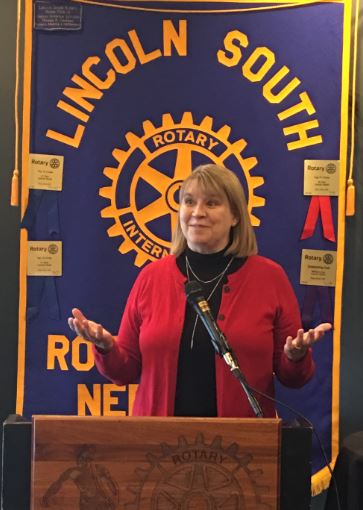
On December 28 at Lincoln South Rotary Club we heard from Dr. Denise Bulling, a Nationally-known speaker on Disrupting the Pathway to Violence.
Denise started her presentation by stating that she wanted to make two specific points:
- Targeted Violence is a process - it is not a compulsive act
- There is a path=way to violence - and it can be disrupted
She shared a story about the high-profile killing in Hollywood that turned the page on laws and training to protect against targeted violence.
The story was about Rebecca Schaeffer a young actress from the show My Sister Sam. Her stalker, John Bordo, was able to get her home address and fatally shot her when he tried to visit her. The Los Angeles police said that was a tipping point and they created the first team specializing in stalking investigations. and, there are now anti-stalking laws in every state.
Dr. Bulling used photos of cats to explain the differences between:
- Affective or Reactive Violence - not targeted - defending yourself (a kitty with back arched)
- Predatory or Instrumental Violence - stalking for prey - this is targeted violence (crouching cat, watching the potential catch); slowly and methodically moving toward the goal; there is intent
Those that are trained in disrupting targeted violence, they need to look for those types of behaviors. We need to understand that targeted violence is a process - it does not just happen.
Targeted violence comes in many forms
- Workplace Violence
- Harassment
- Bullying
- Sexual Assault
- Physical Assault
- Threats (direct & veiled)
- Suicide
- Violent Extremism
OSHA now has guidelines in place for protecting against targeted violence, primarily in social service and healthcare industries (primarily women workers).
There were a number of papers written on targeted violence as studies are preformed in the 90s. Research has indicated that there are similarities in the cases. These have all contributed to the research and development of programs to protect against targeted violence.
Some of the writings Dr. Bulling pointed out:
- Protective Intelligence Threat Assessment Investigations - written after the assassination attempt on President Reagan
- Hunters and Howlers in the Workplace - If there’s a howler around, you’ll know it—he or she will make threats, get attention and frighten. But hunters will lie in stealth, avoiding notice, until they strike out to wound or kill.
- The Gift of Fear: And Other Survival Signals That Protect Us from Violence
It was evident that there were patterns in the behavior of offenders. Law enforcement determined that they needed to work with mental health providers.
In today's world we are dealing with mass shootings. Even though the targets are different, the behaviors of the offenders remain the same. The pathway to violence: The Grievance (motive) -> Ideation (justify violence) -> Research / Planning attack ->Preparation ->Breach
Many of us have grievances, but the vast majority of people do not get violent. When a person moves to justification that is radicalization.
Dynamic assessment processes can make a difference. It involves: Assess Threat -> Choose Intervention -> implement intervention -> monitor and evaluate
While trying to put the information together we need to find out as much information as possible from all resources. If something is reported, it is only one piece of the puzzle. It may be reported to:
- Law Enforcement
- Mental Health Professionals
- Friends & Family
- Coworkers / Workplace
Then threat assessment is used to determine:
- Who knows what?
- Who knows about the target?
- Who knows about the threatener?
- Who knows about the setting?
In Nebraska - in ever public school - there are threat assessment teams getting trained. There are a number of programs in place across the state such as "See Something Say Something".