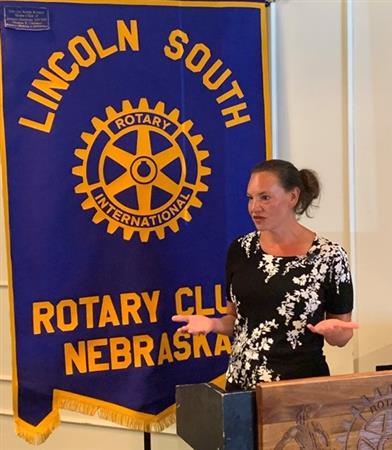
Danielle shared how she got interested in politics and what drives her to work hard for the citizens in Nebraska.
She first became interested in politics at an early age. She was watching Mel Mains interview candidates for Governor. It was the 1986 historic race with two women - Helen Boosalis and Kay Orr. Danielle was inspired and wanted to learn more - and be part of this historical event. She decided to become a Democrat and support Helen.
Her parents supported her interest - taking her to the campaign office of Helen Boosalis. She picked up brochures, yard signs and other campaign materials. She knocked on doors and distributed information in her home town of Staplehurst and also in Seward.
Helen accepted her invitation to visit her country school in Staplehurst. She spent the entire day with the students and talked about government, politics and public service. Danielle read everything she could about serving the pubic and became life-long friends with Helen - and Helen became a mentor.
Danielle worked her way through college and worked on many campaigns. She did not know how to break into public life. But, realizing that most of the people she knew in politics had a law degree she decided to go in that direction.
She worked as a lawyer for a number a years. When David Landis was not able to run in 2006 for legislature (after multiple terms) due to the enactment of term limits, Danielle decided it was time to move forward with her political career. She was elected and served from 2007 to 2015 and then was not able to run due to term limits. She ran again and elected back to the legislature in 2022.
In deciding to reenter politics, she shared her observations about things shifting. She was concerned with changes that seemed out of line with what we are as Americans and particularly as Nebraskans. She wanted to bring her experience and knowledge of rules and processes back to the legislature. She was well known for her work on behalf of human rights.
The 2024 session was incredibly divisive - not only in citizen engagement but was happening on the floor of the legislature.
Danielle shared that a group of senators came together in the wake of the low point. They worked from the standpoint "this is not what we are". They spent a lot of time working hard - visiting each others' districts, sharing discussions. There was a clear understanding that there would continue to be loud voices. But if a core group came together - and stayed together - they would be able to set a path that was more like what we are.
It was hoped that they could reset the tone - debate in thoughtful ways that would sustain relationships.
It may be that the level of toxicity - of divisiveness - may not be an accident. It turns people away from the ballot box and for running for office. People turn away and feel that they don't want to be a part of it. Each time a person chooses to stay out of the conversation is has a negative impact on our democracy.
Additional comments during question / answer:
There may be a special session to address taxes; she invites the opportunity because she believes that are many options and that will give the time and platform to review all of the options.
When talking about term limits she commented that one of the negatives that is pointed out with term limits is that new senators don't have much time to get experience and be extremely effective. They have to learn the process, build relationships, and learn who might be best to approach in certain situations. With little time in their positions, senators may find it more comfortable to revert to the talking points of their political party.
Danielle Conrad was first elected to Nebraska Legislature in 2006 and reelected in 2010 and 2022.