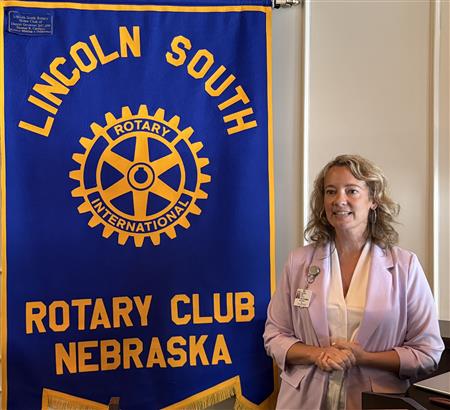
On May 30, 2025, Lincoln South Rotary Club heard from Valerie Hunt of Bryan Health, their 100th anniversary and challenges in rural health.
It was 1921 - Robert E. Moore left $100,000 to the Lincoln Hospital Association in his will. In order to create a hospital, the association issued a challenge to the city of Lincoln to match those funds. The Rotary Club of Lincoln (now Lincoln 14) led the campaign to raise the money. There were opportunities to become members of the Association and attend fundraising events.
William Jennings Bryan & Mary Baird Bryan, having moved away from Lincoln, donated their vacant home and the 8 acres of land to the Association.
But Lincoln General Hospital was first - opening a hospital with 135 beds and 20 bassinets on March 23, 1925.
On June 5, 1926 Bryan Memorial Hospital opened with 50 beds. There was actually a patient there before the hospital was totally finished and they delivered their first baby on June 7.
Both hospitals opened nursing schools at the same time as the hospital opening. Lincoln General started with 25 students and Bryan School of Nursing started with 15 students.
Philanthropy continued into the 30s. With a donation from John Teeters, Lincoln General was able to purchase the world's largest x-ray machine. Lincoln General was also the first in the country making a commitment to mental health. Another purchase was the iron lung.
Throughout time, there was a lot of rapid growth. Frequently all three hospitals in Lincoln had construction going on at the same time. There was a constant need for increasing beds, units and services.
Lincoln was the first in many medical advances:
•1966 First Open Heart Surgery in Nebraska @ Bryan
•1966 First in the US, Mobile Life Support @ Memorial Stadium
•1970 Nebraska’s First Cardiac Vein By Pass
•1971 Nebraska’s First Mobile Heart Unit (6th in the US) & ACLS
•1971 LGH Independence Center OpensWe heard the story about the opening of the trauma center at Lincoln General Hospital in 1978. Dr. James Styner, along with other physicians, began discussing the need for a fully integrated trauma center at Lincoln General Hospital. Dr. Styner's own experience with his family's plane crash, where he and his children survived but his wife did not, provided a powerful impetus for the development of a trauma program.
Valerie continued to share things that happened at the hospitals:
•1980- Tele-Med Program Begins
•1981- First balloon angioplasty performed
•1981 – Dr. Patricia Stivrins opens Infant Sleep Apnea Center
•1983- Terms of Endearment is filmed at LGH
•1986- First Heart Transplant in Nebraska
•1992- First Lung Transplant in Nebraska
•1992- First Lung Transplant in Nebraska
Bryan and Lincoln General Hospital merged in 1997 which resulted in an endowment of $37million. That was the start of the Community Health Endowment of Lincoln which has since returned $40million in grant funds focusing on health initiatives.
One very impactful event to the hospital system was the Pandemic which, as Valerie stated "was very real". From March 2020 through 2023 there were 4483 covid patients and 551 deaths. The hospital staff continued to report to work while many of us were working from home.
The Bryan family has been expanding to serve more people in Nebraska.
•1997- Bryan Memorial & Lincoln General Hospital Merge
•1999- Crete Area Medical Center
•2017- Merrick Medical Center
•2020- Grand Island Regional Medical Center
•2022- Kearney Regional Medical Center
•1999- Crete Area Medical Center
•2017- Merrick Medical Center
•2020- Grand Island Regional Medical Center
•2022- Kearney Regional Medical Center
Valerie shared a glimpse into the future of medicine.
Robotics developed at the University of Nebraska-Lincoln have been used to successfully perform surgeries. Upon development, they tested the equipment while the patient and doctor were in the same room - then the same building - then across town. After that they tested while the patient and doctor were separated - to Des Moines, the to Chicago, and finally on the space station. The doctor "doing the cutting" was in Lincoln while the patient was remote.
One major benefit will be how to best serve remote patients. There are so much of our population that is not near the facilities that are needed to best treat them. Robotics may provide an option. It is beneficial when surgery is time-sensitive - there is not time to get the patient to a facility or send a team out to the location of the patient.
With that in mind - Valerie shared that maternity care is not moving in a positive direction. More facilities are closing. Not only will it be difficult to have access to delivery, but many do not get good pre-natal care. That has caused an increase in the number of premature births and need for neonatal intensive care. Those patients are not in the hospital for days - it is months and maybe a year. Which goes back to the issue of not having facilities for any maternity care. With so many maternity units closing, there is more pressure on the Lincoln facilities - and we are not ready.
Bryan Health saw the need for more trained professionals. They set up the school for 500 students. But they are seeing enrollment of 800.
Valerie shared this website - https://beyond100.bryanhealth.com/
Lincoln South Rotary Club has made a commitment to provide substantial scholarships to students in the health services fields.
BIO
Valerie Hunt grew up in Walton, Nebraska (born at Lincoln General Hospital- now Bryan West) as the 5th generation working on her family farm. She has a marketing and business degree from Northwest Missouri State University and an MBA from Regis University.
Before returning home to work at Bryan Health. Valerie worked for the University of Northern Colorado Foundation and West Virginia University College of Law. In 2012, Valerie, her husband Adam and their three sons moved back to Nebraska where today she is the Executive Director managing philanthropy for the Bryan Foundation.
Outside of work, Valerie enjoys all fishing and lake time with her family, a good kickboxing class and singing classic oldies while driving.