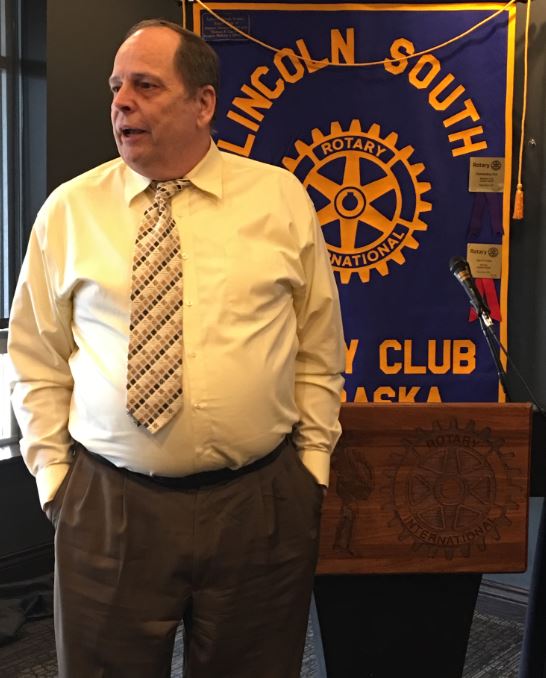
The topic was complex but interesting.
Wally told us about the various projects currently underway - or recently completed - by the Biological Process Department.
Right here in Nebraska, we are involved in amazing innovations in disease prevention and treatment.
They work on biotherapeutics or biologics - creating medicines / vaccines from living organisms; those medicines / vaccines are used to prevent or treat a number of diseases. They work under FDA guidelines so, as they are working on products, they are getting them ready for human injection.
Wally told us about advancements in production of products such as insulin. Prior to the early 80's, insulin was only produced from the pancreas of a pig. One pancreas could produce about 3 doses of insulin. Today, with the development of insulin using modern processes and DNA technology, insulin can be produced from yeast, plants, insect cells, etc. With those developments there are more options / more efficient options to produce insulin.
He explained that generally a project comes to his department after someone has discovered a new biologic - a new use of a protein. His department then goes to work to create the product, document, test, and analyze. There are many tests along the way and very detailed documentation. By the time they are done with the project, the product is generally ready for human consumption.
Their analytical process provides a good track of who the produces are and the distribution of the product. Their documentation provides details of production. That information is needed to determine test results and provide proof that the product is ready for consumption.
A critical part of this process is "scaling". They start by producing on a small scale. But then they create some large-scale tests - scaling the details of the product to a level that may be produced in a factory environment. This is all part of the development and testing that is required before a product reaches the consumer.
Some past projects included research and products for bio defense. They are currently working on a product that will prevent the transmission of AIDS and an anti-cancer product.
Speaker Bio:
Wallace Buchholz is the director of the Biological Process Development Facility at the UNL College of Engineering.
The BPDF develops processes to manufacture a variety of biological molecules, including vaccines against bio-terror agents such as ricin and anthrax. An ongoing project includes developing a production process and manufacturing a microbicide that will undergo clinical trials to fight HIV in developing countries. The facility has also developed processes to help enable the production of vaccines to protect against some botulism serotypes.
Buchholz came to UNL from Durham, N.C., where he led the Army Research Office microbiology research program for more than six years. At ARO he was responsible for identifying and funding cutting-edge, basic research in microbiology that has relevance to the Department of Defense.
He succeeds Michael Meagher, who was the BPDF’s director since its founding in 1990.
Buchholz earned his Ph.D. in Bacteriology and Public Health/Microbiology from Washington State University with an emphasis in host/pathogen interactions. Prior to working for the Army Research Office, he was a microbiologist/molecular biologist at the Army’s Dugway Proving Ground Life Sciences Test Facility, the Alaska State Public Health Laboratory, the U.S. Fish and Wildlife Service and Texas A&M University.
His work in the past 15 years has focused on bio-defense. Much of Buchholz’s research portfolio at ARO was devoted to microbial adaptation and forensics.
"In essence, microbiology is adaptation," he said. The more we understand how microbes adapt to their environment, the more we will know how to control and defend against them and thus defend against natural or man-made disease outbreaks.
The BPDF is a phenomenal facility with enormous potential, Buchholz said.
"Among its challenges are integrating its business and educational operations," he said. "The need for trained personnel to make these specialized biological products in production facilities is growing exponentially."
Buchholz cited innovative technologies in therapeutics and vaccine production with the potential for enormous impacts on the ability to protect people from known and emerging pathogens.
“I envision ways that the facility can specialize to advance some of these new technologies and transition them from the research bench to clinical trials," he said.